The growth of on-demand delivery services has created more options for independent couriers, yet it has also introduced variability in pay, schedules, and platform support that may influence a driver’s long-term earning potential and work-life balance.
Introduction
The expansion of on-demand delivery platforms has reshaped local logistics and provided many Californians with an avenue to earn income as independent contractors. While platforms often highlight flexibility and supplemental income opportunities, empirical studies and driver reports suggest important differences in compensation structures, the practical availability of flexible schedules, and the quality of platform support. This analysis draws on recent California-focused research, policy reporting, and platform practices to outline how earnings, scheduling, and driver satisfaction compare across DoorDash, Uber Eats, and Instacart. Relevant sources include a 2024 Business Insider synthesis, Berkeley Labor Center estimates, and policy reporting on Proposition 22 enforcement (see Business Insider, Berkeley Labor Center, CalMatters links embedded below).
1. Comparative Analysis of Earnings and Compensation Models Across Platforms
Delivery platforms use a combination of base pay, distance or time adjustments, tips, and time-limited incentives to determine the pay a driver receives for each order. The composition and transparency of these components differ by company, and these differences can materially affect both gross and net earnings. Some broad observations from recent California-focused reports and platform data:
• Pay components and transparency: Base pay formulas vary—some platforms present a breakdown for each order, while others emphasize an aggregated payout. Tips are handled differently by platform policy and may represent a meaningful portion of gross earnings for food delivery drivers. Platforms also deploy surge-like incentives (peak pay, guaranteed earnings, bonuses for completing a set number of deliveries) that can raise short-term gross pay but are often conditional and time-limited (Business Insider; Fairwork US 2025 Report: https://fair.work/wp-content/uploads/sites/17/2025/03/Fairwork-US-2025-Report_Web-2.pdf).
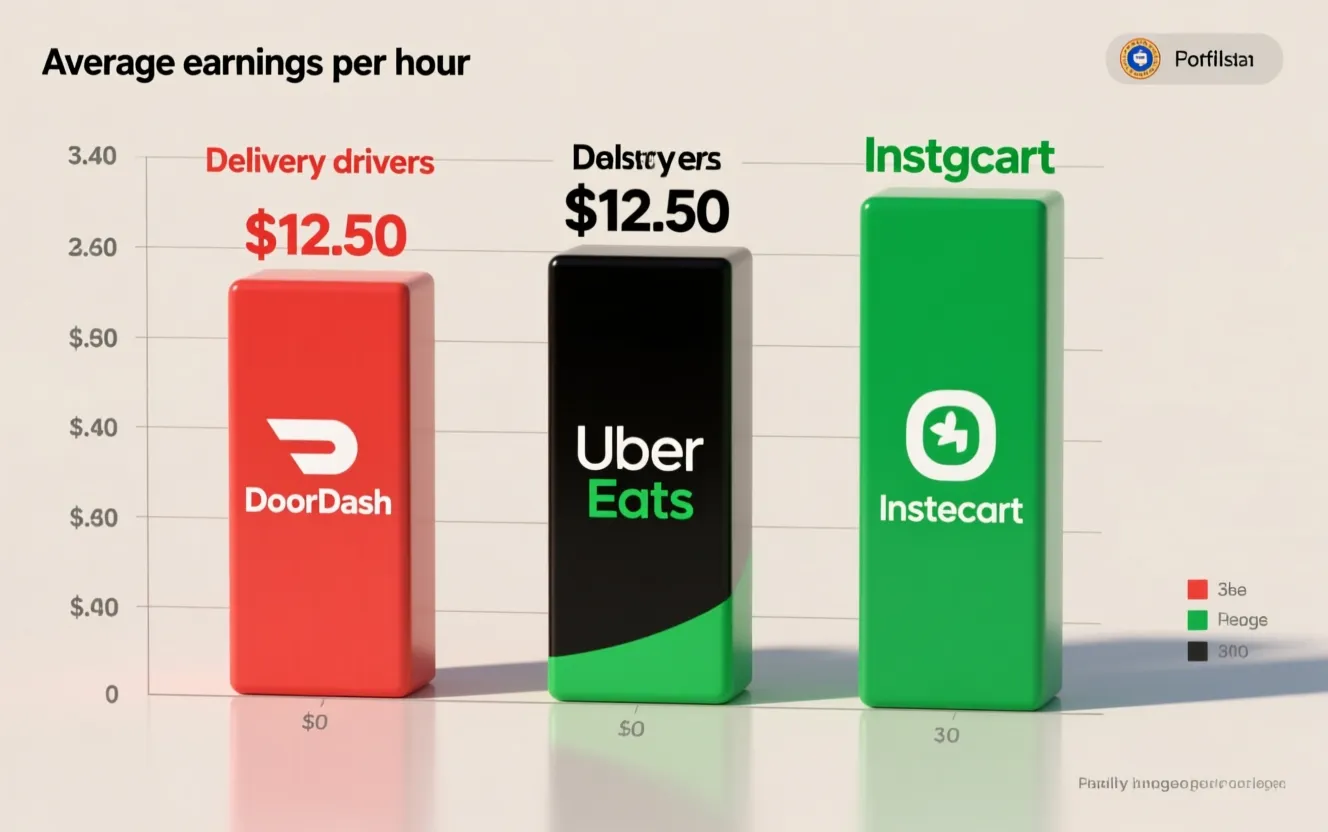
• Reported gross earnings (estimates): Estimates of gross hourly earnings in California vary across studies and depend on whether tips are included. A May 2024 compilation reported median gross hourly earnings for delivery drivers in California at approximately $21.10 (including tips) (Business Insider: https://www.businessinsider.com/uber-lyft-doordash-drivers-earn-below-minimum-wage-tips-study-2024-5). Platform-specific estimates reported in industry analyses suggest DoorDash average gross hourly figures near $11 in some comparisons, while other driving-based platforms (e.g., Walmart Spark Driver) have been reported at substantially higher averages—in some cases above $20 to $25 per hour—highlighting platform heterogeneity (Gridwise; AOL Finance coverage: https://gridwise.io/blog/uber-eats-vs-doordash-pay-how-much-are-drivers-earning; https://www.aol.com/finance/fees-rising-much-faster-gig-154959701.html).
• Net earnings after costs: Multiple studies caution that vehicle-related costs (fuel, maintenance, depreciation, insurance) substantially reduce take-home pay. A study of rideshare drivers in California found net hourly earnings could decline to around $6.20 per hour after accounting for work-related costs; while that study focused on passenger transport, analogous cost pressures apply to delivery drivers who rely on personal vehicles (National Equity Atlas / Prop. 22 analysis: https://www.nationalequityatlas.org/research/analyses/prop-22-pay-study). Thus, gross hourly figures may overstate financial sustainability unless drivers account for operating expenses.
• Incentive programs and variability: DoorDash, Uber Eats, and Instacart operate different incentive schemes. DoorDash often uses drive-time bonuses, streak bonuses, and occasional guarantees; Uber Eats pairs time/distance multipliers with surge pricing in some markets; Instacart provides batch pay for shopping plus delivery and offers peak-time bonuses for shoppers and drivers. These incentives can raise short-term earnings but vary in availability and predictability, which affects income stability.
PlatformRepresentative Gross Estimate (CA)Typical Pay ComponentsDoorDash~$11/hr reported in some industry comparisonsBase pay + tips + distance/time adjustments + bonuses/guaranteesUber EatsVaried; platform-level medians differ by study and marketBase fare + distance/time + surge/boosts + tipsInstacartVaried; shopper + delivery components; earnings depend on batch size and tipBatch pay (shopping) + delivery fee + tips + peak incentives
Note: Values above are reported estimates drawn from recent analyses and driver reports; they should be interpreted as indicative rather than definitive (Business Insider; Gridwise; Fairwork US 2025 Report).
1.1 How distance, time, and order type affect earnings
Order attributes—such as trip distance, complexity (e.g., multi-stop orders), and wait time—directly influence platform-calculated pay. Longer deliveries may yield higher base distance pay but also increase drive time and vehicle expenses, potentially lowering net hourly returns. Time-of-day and peak incentives can change effective earnings per hour by increasing order volume or per-order pay during busy windows. Drivers who multi-app (use multiple platforms concurrently) may increase their acceptance rates and reduce idle time, but multitasking can increase complexity and wear on a vehicle.
Scholars and policy analysts advise drivers to account for both gross payout and expected completion time (including pickup and wait) when assessing an order’s contribution to hourly income (Fairwork; HRW report: https://www.hrw.org/report/2025/05/12/the-gig-trap/algorithmic-wage-and-labor-exploitation-in-platform-work-in-the-us).
2. Work Flexibility and Scheduling Differences Among Delivery Services
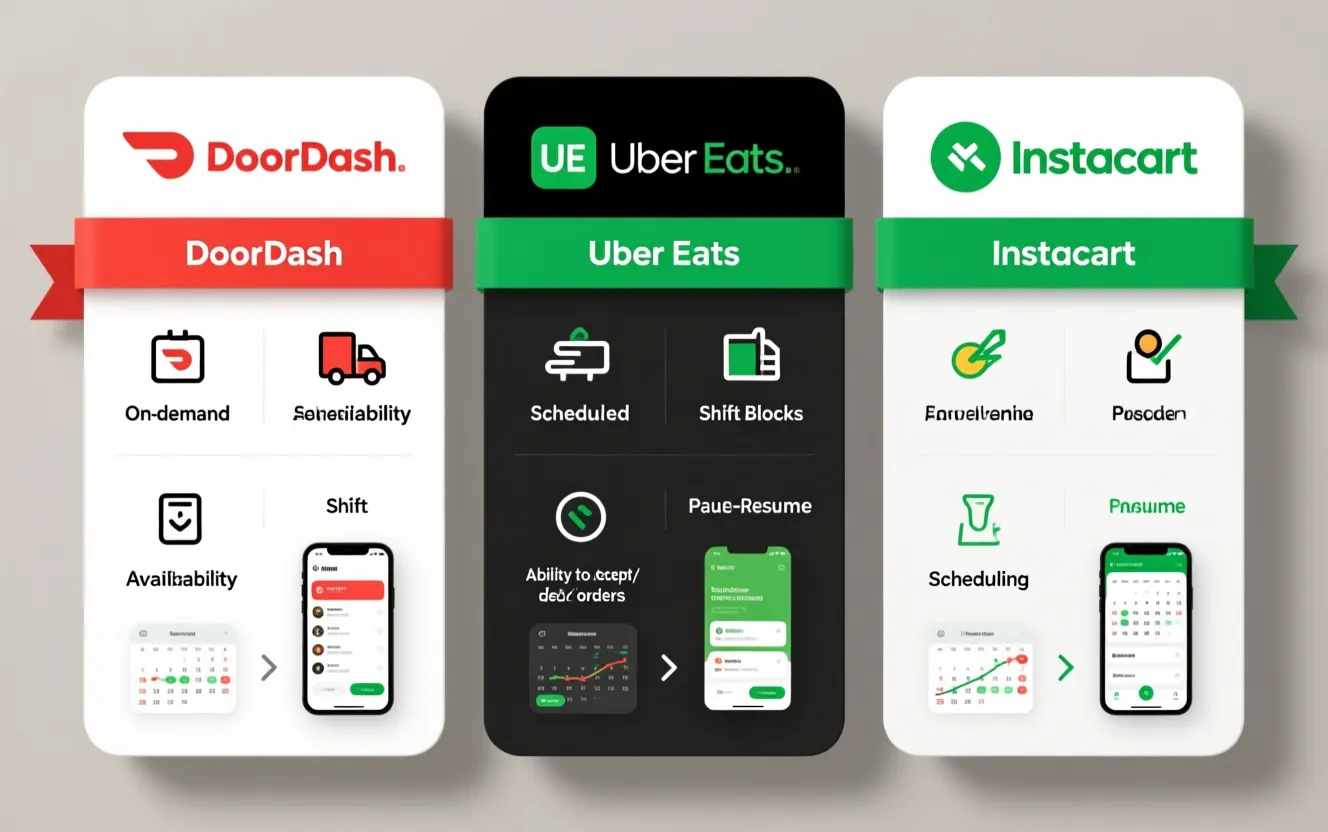
Platform-promoted flexibility is a key attractor for many couriers. However, the practical experience of flexibility varies by platform policy, market saturation, and the driver’s reliance on platform incentives.
• Open scheduling vs. required commitments: DoorDash and Uber Eats are commonly characterized as “on-demand” platforms where drivers can sign on and accept orders without pre-scheduled shifts. Instacart historically provided two primary modes: “full-service” shoppers who may accept batches when available and “in-store shoppers” who work more scheduled shifts depending on store agreements. All three platforms may also offer optional scheduled blocks or peak windows that carry guarantees or higher pay but may require drivers to commit to being available for that window to access enhanced pay.
• Interface and ease of scheduling: Platform apps differ in how they present availability and scheduled opportunities. DoorDash uses “dash” activation and scheduled dashes; Uber Eats offers boosts and scheduled delivery blocks in some markets; Instacart’s shopper app shows available batches and scheduled shifts in metro areas with high demand. Driver testimonials often highlight that scheduled incentives can be valuable but may require advance planning and sometimes compete with spontaneous local demand.
• Platform-imposed constraints and practical autonomy: In practice, drivers report that conditional incentives (e.g., guarantees for accepting X deliveries in a block) can create de facto expectations that reduce a sense of autonomy. Additionally, algorithmic assignment and penalty systems for rejecting orders or failing to meet acceptance thresholds may influence how “free” drivers feel to decline work. Policy reporting on Prop. 22 also suggests that statutory frameworks intended to preserve certain platform flexibilities have not uniformly translated into predictable protections or earnings (CalMatters: https://calmatters.org/economy/2024/09/gig-work-california-prop-22-enforcement/).
2.1 Flexibility trade-offs and multi-platform strategies
Many drivers adopt multi-platform strategies (signing into DoorDash, Uber Eats, Instacart, and sometimes others) to smooth demand fluctuations and reduce idle time. Multi-apping may increase gross hourly revenue potential by allowing drivers to choose the most lucrative orders available at a given time, but it also increases cognitive load, logistical complexity, and potentially safety risks if drivers handle multiple active navigation instructions simultaneously.
Drivers considering scheduling strategies should weigh predictable scheduled blocks with potentially higher but contingent pay against purely on-demand work that may offer immediate autonomy but less predictable hourly volume.
3. Driver Satisfaction and Retention Factors in Multi-Platform Gig Work
Driver satisfaction and retention hinge on a combination of earnings stability, perceived fairness and transparency of algorithms, timely customer support, and community or peer networks that help drivers navigate platform practices.
• Earnings stability and predictability: Survey-based research suggests that pay consistency is a dominant factor in driver satisfaction. Drivers who experience large swings in weekly income or who must devote additional unpaid hours to vehicle upkeep report lower satisfaction and a higher likelihood of leaving platform work. Incentive structures that are unpredictable may increase churn, even when peak bonuses temporarily raise gross earnings (Fairwork US 2025; HRW: https://www.hrw.org/report/2025/05/12/the-gig-trap/algorithmic-wage-and-labor-exploitation-in-platform-work-in-the-us).
• Platform support, dispute resolution, and communication: Drivers report variation in how quickly platforms handle issues such as missing tips, payment discrepancies, or account deactivations. Platforms that offer accessible, timely dispute resolution and clear communication channels are more likely to retain drivers. Some platforms provide driver-focused resources (in-app help centers, phone support for certain issues, local driver hubs), but driver reports and independent reviews indicate these supports remain uneven across markets.
• Community and peer resources: Driver-run communities, local meetups, and online forums provide important informational and emotional support. These networks often share practical tips for reducing costs, identifying profitable shifts, and navigating platform policy changes. Such communities can buffer drivers from negative experiences and may contribute to higher retention when they facilitate knowledge transfer and advocacy.
3.1 Evidence from California and policy context
California’s policy environment—particularly the debates and implementation around Proposition 22—has shaped platform-driver dynamics. Some reports argue that Prop. 22’s design created alternative benefit frameworks that fall short of traditional employment protections and may not adequately address income instability or operation-cost burdens (National Equity Atlas; CalMatters). Enforcement gaps and contested interpretations of benefit adequacy can affect drivers’ perceptions of long-term viability and satisfaction with platform work.
Incorporating qualitative input, drivers often highlight the practical benefit of flexible grocery shopping shifts in Instacart—where the combination of in-store shopping and delivery can feel more active and structured—echoing the casual video-style testimony often shared by Instacart couriers describing shopping and delivering as a flexible routine that supports local customers (e.g., “Hey friends! Just wanted to share my experience delivering with Instacart. It’s pretty cool — you shop for groceries at local stores and bring them right to customers’ homes. Makes grocery shopping more flexible for everyone!”).
Practical Considerations for Drivers Evaluating Platforms
For drivers deciding whether to work on one platform or several, or how to allocate time, the following practices may help manage uncertainty and improve economic outcomes:
- Track net pay per hour: Record gross payouts alongside time spent, mileage, and vehicle costs to estimate net hourly return for different order types and times.
- Test incentive windows: Experiment with scheduled blocks and peak windows to determine if the conditional incentives reliably improve hourly returns in a given market.
- Use driver communities: Leverage forums and local groups to learn about shifting demand patterns, practical shortcuts for reducing wait times, and the best practices for handling disputes with platforms.
- Assess multi-apping trade-offs: If running multiple apps, prioritize safety and clarity (e.g., focus on one active navigation at a time) and monitor whether multi-apping materially increases accepted high-pay orders relative to added complexity.
Conclusion and Recommendations
Comparing DoorDash, Uber Eats, and Instacart in California highlights three linked realities: compensation structures are heterogeneous and often complex; flexibility is operational but can be constrained by conditional incentives and algorithmic expectations; and driver satisfaction depends heavily on pay predictability, platform responsiveness, and community support. Recent empirical work suggests that while reported gross earnings may appear to reach or exceed local wage thresholds in some studies, net earnings after operating costs can be substantially lower, which has important implications for long-term financial viability (Business Insider; Berkeley Labor Center; National Equity Atlas).
For drivers: consider systematically tracking net pay (including vehicle costs), experiment with scheduled windows to understand their reliability, and use multi-apping strategically rather than reflexively. Engaging with driver communities can surface practical tactics and reduce information asymmetries.
For platforms and policymakers: improving pay transparency, standardizing dispute-resolution timelines, and designing incentives that emphasize consistency as well as short-term peaks could help reduce churn and support longer-term retention. Independent, regularly updated regional studies that disclose gross and net earnings would also help drivers make informed choices and help policymakers assess whether existing regulatory frameworks provide adequate protection and predictability.